Pages

Tuesday, January 10, 2012

Education: They're afraid of us because we're not afraid

"We do not want to improve the actual system: we want a profound change- to stop seeing education as a consumer good. To see education as a right where the state provides a guarantee. Why do we need education? To make profits. To make a business? Or to develop a country and have social integration and development? Those are the issues in dispute."

Camila Vallejo

"The broader issue in this struggle is that like so much of the system in Chile, it favors the wealthy. The richest 20% of households earn half the national income and the bottom 20% earn just 5% of the national income. The government insists that the economic growth of the country will have a trickle down effect and all will feel the benefits but it seems the rich are staying rich and the poor, poor."

"Chile is a profoundly unequal country. The opportunities people have depend on what positions their parents have in society. The student movement seeks to level the playing field and expand opportunities."
- Patricio Navia, Chilean Political Scientist at NYU.


On January 4th the Chilean Senate took a vote on a bill that would end for-profit educational institutions from receiving state funding. The bill came as a direct result of the lengthy and ongoing student protests and won approval by a vote of 22-12. The bill still has a number of hurdles to overcome in the legislative process but it is a notable concrete step in the right direction to bringing change to education in Chile.

Unfortunately for the students, but fortunately for me, as this post never materialized in a timely manner, not too much earth shattering changes have come about yet due to the protests. However, the wheels are in motion.

In addition to the bill which is expected to be hotly contested and brought in front of a Constitutional Committee due to questions of constituionality, the government has agreed to an increase of 7.2% for education spending in 2012. Not the sweeping dramatic changes that the students have hoped to instill, but the message and mission remains strong and there seem to be chinks in the armour of the educational establishment that has served as the norm since the Pinochet Dictatorship. Heads within the government are still rolling, a sign that the pressure is building to institute change.

Joaquin Lavin, served as the Minister of Education for a little over a year before resigning in July due to pressures from the protests.

 "I'm Cheating you"
Lavin attended the University of Chicago where he got a masters in economics. He also wrote a book "Una Revolucion Silenciosa" "A Quiet Revolution" in support of the Dictator Augusto Pinochet's policies. Clearly he wasn't going to jive with the students.

Felipe Bulnes, lasted from July to December as Minister of Education.
"Finland is the country with the highest rated educational system and it is 99% state funded. In Chile, this would be a great step backwards"- Felipe Bulnes. (Not an actual quote, but a satirical portrayal of the students' view of Bulnes' policies.)

Bulnes has a Masters from Harvard.

And public enemy number one and still standing, billionare businessman, President Pinera.
He also got a Masters from Harvard in Economics. A little strange how the ruling elite, the good old boys, all seem to study at the most prestigious universities in the United States . . . But there is no problem with the educational system in the country.

Harald Beyer is the newest Minister of Education, he was appointed on December 29th.
Oh and Beyer also studied in the U.S., he got a Doctorate in Economics from UCLA.

Many see Beyer as an expert in education with little political experience, which can be both a positive and negative. He has served as a consultant on educational matters for President Pinera and the previous president, as well as, working on the educational committee for a think tank, which personally does not install a lot of confidence in me because Joe and I used to call our room "the think tank" when we watched youtube videos under the knife mobile instead of doing homework, I hope theirs was different than ours (except for the knife mobile, all think tanks should have a knife mobile). The students see him as potentially being the right man for the job with important educational expertise but are afraid he may be easily handled by experienced politicians and not be able to institute the desired changes.


In light of the Occupy Protests in the U.S. I think it is important to compare and contrast it with the student movement in Chile. The most evident similarity is the fact that they both appeal to almost all demographics and all people. However, I see two important differences. The first, taking into consideration an observation of Patricio Navia, a Chilean political scientist who has voiced the fear that the student movement is going to lose momentum:

"It will be remembered as being ideologically pure, but not very effective. Looking for the revolution, it will lose the ability to influence gradual concrete change in the right direction."

I believe that in Chile, thus far, they have avoided this. The clear cut goal of the student protests is still to make quality and free education available to all Chileans. Keeping that in mind and driving toward that tangible goal is what has enabled a dialogue with the government and actual change to be possible.

In contrast, this is exactly how the Occupy Movement has come to be remembered. Occupy came to deal largely in the abstract, instead of keeping with a tangible goal, like that of the original Occupy Wall Street which was to bring Wall Street under greater public scrutiny and bring those who acted criminally, to justice. I personally could have seen a lot of good in channeling the protests to create funding to establish an independent watch dog group to keep an eye on the Wall Street establishment, but that is difficult to do without coordinated action. In the end the movement became a hodgepodge of causes across the U.S. and the camps came to be perceived as cauldrons of discontents and whiners who were envious of those who have more than them.

I think this video speaks for itself and is conveniently topical.

Somebody write this kid a check! (I knew he was in trouble when the one source he cited for his facts was the internet.)

The second observation, which I think is strongly connected to why the Occupy movement fizzled out was the refusal to define a leader. Clearly, one of the strongest aspects of the student movement in Chile is the strong and dynamic leadership. This leadership has been able to create a two day national strike and has opened a dialogue with regular meetings between students and the government. The movement has a voice and actions can be directed and coordinated.


Closing Notes:
- According to a nationwide standardized test administered to seniors, the test results between public and private schools has increased each year since 2004. The max score is 850 and in 2004 the average gap between public and private school kids was 118 points and as of last year private school kids were outscoring their public school counterparts by an average of 157 points.

-  This is the biggest movement in Chile since the end of the Dictatorship and people do not have the same fear of the government that existed before. "We don't have the fear our parents did because we never lived in the dictatorship," - Student leader Camila Vallejo.

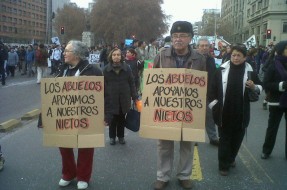
- Older generations that previously held their tongues because of the memories of the cruely of the dictatorship are also being inspired by the students and finding their voice.
- The dynamic young leader, Camila Vallejo lost reelection of the University of Chile's student federation, the largest in the country (FECh).
Camila and used tear gas canister peace sign

She is now the vicepresident behind Gabriel Boric, a 23 year old law student. Boric is not politically affiliated like Camila Vallejo was to the Communist Party and seeks to keep the arenas separate with the focus staying on education.

- The movement is slowing down for the summer break, the Universidad de Chile is not being occupied by the students for the first time in more than 6 months. However, around 70 schools/universities will remain occupied.

This is where things stand today with the student movement, it will be interested to see where the movement goes with the new Minister of Education and the new president of the University of Chile student federation. The movement seems to be at a fragile point where momentum can be lost and it will fizzle out, like the Occupy protests but I have a feeling that the passion of the students, the decades of building discontent, and the progress that has already been made will keep things moving forward.


For those interested, I've put together a playlist on youtube with videos that cover all aspects of the movement. Different scenes from the protest, violence between protesters and the police, the interruption of government meetings by students, the President of Chile being asked about the movement during a visit to Harvard and an interview with Camila Vallejo, and if you are very ambitious a 30 minute documentary on the movement that is subtitled in English (you have to press the CC button), I've only watched the beginning which opens with a massive dance to Thriller in front of the Presidential Palace, La Moneda.
http://www.youtube.com/playlist?list=PL76AE10B8E116984D

For now, I leave you with this:

Tuesday, September 20, 2011

Education: The Heart of the Issue

From personal experience it seems that education in Chile is in a fragile state. Before leaving to study abroad you are warned that there is always a chance for strikes.
As the semester starts up, one of the strangest things you will notice walking down the street, apart from the freshman covered in fish, paint, and condiments (picture on the right) begging for change to get their shoes back from the upperclassmen, are the droves of university employees accosting you with pamphlets. These pamphlets offer deals on admission and the various courses they offer. It almost feels like walking down a street populated by bars and bar promoters trying to get you to come in for a drink special . . . Except in this case, you are not just going to get a buzz on, it's for your education and future.


Another aspect of the education system that drew my attention and is distinct from the United States is that you pay depending on what major you select. For example, to study engineering or biology, the tuition per semester is much higher than to study a noble but largely useless subject, like Political Science.


How did it end up like this?


The public universities are for-profit institutions. Wait, what? Yes, the universities are designed to bring in the $$. During the Pinochet dictatorship, he introduced many neoliberal policies to all industries, including to education with the idea that competition between universities would improve the quality of education and as a result public universities were converted into for-profit institutions. In addition, Pinochet transferred funds that were previously used to subsidize the public universities into a voucher system that parents could use to enroll their children in private schools and universities. As a result private universities sprung up that could cash in on the voucher system and continued to appear in the early 1990's and 2000's after the Dictatorship ended.

Part of the problem with so many small private universities is the lack of uniformity in the curriculum and inability to control the quality of the education. As I said, it feels like a bit of a crap shoot walking down the street and being handed a pamphlet from 10 different universities advertising what they have to offer and recruiting you to enroll . . . If I remember correctly when I applied to college I had to fill out a dozen applications, interview, and in the end beg a college to take me.

These policies seem to have had mixed results. Middle classes moved their students out of public schools as the quality deteriorated and poorer students who have stayed in the public schools tend not to test as well and are forced into attending private universities that can be more expensive and have a dubious quality of education. More students than ever are attending college, 7 out of 10 are the first in their family, but with funds redirected to the voucher system and similar initiatives, the available resources to help students attend the public universities have dwindled. Students are leaving with massive debts up to $45-50,000, which in a country that has the highest average wages relative to the rest of Latin America, is still an astronomical sum. (The price of education leads to some awkward moments in Chile when a Chilean student would ask how much you pay, a.k.a. that amount per semester but it is so much and sounds so ridiculous that the only way to respond was "a lot" and mention The Simpsons or that you have been to New York as a quick way out of the subject.)

Facts that don're reflect to well on the system:

- Minimal funding is put into higher education- about 2.2% of GDP and just over 0.5% of GDP go toward public universities.

- In 1986, 63% if students were enrolled in public schools. In 2008 about 43%

- 80% of students are in private universities. Loans for private universities have higher interest rates and students are leaving with higher debts.

- Students are using as much as 18% of their salaries over 15 years to pay off debts.- According to a study by the World Bank

That is my best attempt to explain what is going on and what has joined students and teachers, young and old and has dropped the President's approval rating to 26% as they attempt to reform the education system through a massive movement that has been felt by everyone in Chile, but has not been so much as a blip on the radar in these parts.


Thursday, September 8, 2011

Student Struggle Chile: Introduction

"The whole theory of modern education is radically unsound. Fortunately in England, at any rate, education produces no effect whatsoever. If it did, it would prove a serious danger to the upper classes, and probably lead to acts of violence." ~ Oscar Wilde


Chile(Massive protests for education + 3 month shut down of public higher education + 2 day national strike + Riots + Potato sack material student leader + Dictatorial flashbacks )/ (I have no job  x  there is no coverage of this in the U.S.) = New informative post for Us vs. Chile!

Over the last 3 months Chile has been experiencing widespread student protests. Looking at the media coverage the London riots got in the U.S. you'd think that they were the only riots that were going on in the world outside of Syria. Not so my friends, my best educated guess is that London received so much coverage here because it directly affected our economy as metal baseball bat sales went up over %6,500 (wooden only 4,000%, it's like the English don't have any sense of tradition or respect for our national pastime). However, if you were to open a Chilean newspaper you would see similar images on a weekly, almost daily basis.

Let's take a deeper look at some of our variables from the above equation:

Students and professors have joined forces in an ongoing strike that has shut down public higher education and high schools in Chile for close to three months. Over 17 million classes have been cancelled.

Students have taken control of the public universities.


Hunger strikes by students living in their high schools that have lasted over a month:

"I prefer my education before my food."

Kiss-ins . . . sign me up.
(These could actually be pictures from any random day in Chile, where PDA is a favorite pastime.)

A two day national strike led by the biggest union in the country:

"National Strike, Chile should be different: fight for equality." 


And maybe one of the most dynamic young leaders who is becoming a folkloric hero not just in Chile but across Latin America. She has been put under police protection after receiving death threats and a Senior Minister of Culture official in the Chilean government tweeted, "Se mata a la perra, se acaba la leva." . . "If you kill the bitch, you get rid of the litter." A famous phrase used by Chile's 17 year Dictator, Augusto Pinochet, who overthrew the Marxist President of Chile in 1973. And all this time we thought it was just professional athletes getting themselves into trouble on Twitter.

Camila Vallejo, leading student movements and making gas masks
a must have accessory since 2011
Sounds interesting, doesn't it? Well, if you live in the U.S. you are out of luck finding information on this because the only coverage you will find is from business journals worried about the finacial losses expected by companies in Chile as a result of the stoppages.

For all the above reasons I felt the need to write this. I've got about 3 months to catch up on so I'll just go with the basics and try and cover the more interesting story lines.

The central issue: Think Pink Floyd, "We Don't Need No Education" but the opposite.

On the surface it seems like a fairly straight forward concept that should not have lead to such a long drawn out and explosive situation. Like the Hidroaysen project, something on the surface that seemed like a common sense and straight forward initiative, it soon becomes evident that there are a multitude of other factors in the background that need to be taken into consideration. Again, when you factor in Chile's past history, it's future, and the deeply drawn lines in society, nothing comes easy.

Thursday, July 7, 2011

Relegation: The unimaginable a reality for River


It's always tough to put these things into perspective, especially if you have not been to the other place. But fuck it, that's basically the premise for this whole blog, so here we go again.

River Plate is the most successful professional Argentine football club out there. They've won the national tournament 33 times, 10 more championships than any other team in the country. That was until Sunday when they fell to the B Division of Argentine football.

River just didn't recently shit the bed a.k.a. like got a stomach bug for a little and had a few bad games or a bad season. No, River has been in free fall, Montezuma's revenge cronic shitting the bed of sorts for a considerable period of time.

Little bit of background:

In Argentine soccer teams can move up and down between divisions according to performance, which I find to be pretty awesome. Two seasons are played each year and at the end of the second season they add up your total number of points over the last 3 years and 2 teams are sent down and 2 teams are on the chopping block playing for their division 1 life. What this means is that River, one of the most storied teams in South America, has had a stretch of 6 pretty bad seasons which eventually lead to a 2 game home and home playoff this past week with the top team of the B Division.

A semi-decent comparison of the magnitude of what transpired would be to use everybody's favorite (*cough cough*) football team, Notre Dame, as an example. Imagine that as a result of this dismal stretch of football Notre Dame is experiencing that it was moved from 1-A to 1-AA (and still have their games televised nationally). Think about the outcry, the heads that would roll, the drop in value of our picture with Rudy if that were to happen. Now picture that in Argentina where there is no other sport but soccer, with the most successful team, that has the biggest stadium, and a fan base with like maybe two things they love more in life which is probably meat and 1980's British rock music. Shit just got serious.

So you are probably wondering how the 2 game playoff went, well, not exactly to plan for River.


When you are a fan after driving 12 hours to see yout team losing 2-0 to a division 2 team, you may get a little pissed and no fence will hold you:


Getting your ass kicked? Time to rush the field and let them know they have no marbles. Perhaps time to sacrific a live chicken?


Boom. Time to incorporate awesome fact about the team River played, Belgrano de Cordoba. Belgrano is known as Los Piratas because the first time they made it to Division 1 in the early 1900's their stadium did not meet the requirements of a Division 1 field and the players and fans before each game fans borrowed posts, fencing, and wire from nearby homes and businesses to have the field be eligible for play. It looks like they could have used a few extra fences for that game.


Part two brings us to the home half of the playoff for River. Given what happened in Cordoba, this had the makings to be one ugly day in and around El Estadio Monumental for River . . . And it turned out just about as bad as it could have. 2,200 police officers were dispatched to the stadium in addition to the normal security, after league and team officials trounced the idea of playing the game without fans due to what had already happened in Cordoba. I'm guessing the decision to play with fans present probably had something to do with the 19 million dollars of debt River has.


There is one game that I previously wrote about that is considered THE game in Argentine soccer and this game trounced it in interest and viewers. The 2,200 police apparently did little to prevent as many as 14,000 extra ticketless fans from forcing their way in led by the Borrachos del Tablon, the "barra brava" or main backers of River.

River needed a 2-0 win to stay alive, but ended up tying 1-1.


for the English version, with the quintessential British soccer annoucer, click this link: http://www.youtube.com/watch?v=RtBbLpl7tPk. (He missed a classic "this could be trouble!" when the fire hose came out.)


After the game outside:


Closing notes:

- It's not going to be easy to get back to La Primera A for River. The team is in shambles financially and keeps selling its good young players to Europe to try to offset it's financial woes. It's been a revolving door of coaches for River in search of an answer that probably isn't there because it is more a problem of how the club is being run. In the last three years the club has had 6 coaches, each averaging only 19 games at the helm and 64 different players have donned the jersey. They also may have to play the entire season away from their home stadium as a sanction for the violence after the game and for something absolutely ridiculous. Probably the craziest thing to come out of the game and gives you a sense of how corrupt and out of control Argentine soccer is.

At the half River was winning 1-0 but still needed at least one more goal (Belgrano won 2-0 at home, so River had to win this game 2-0 and they get the tie breaker as the division 1 team). Members of la barra, the main backers of River, were let into the inside of the stadium as security and police turned a blind eye to them. The group even received a call from a club official telling them to "do it quickly." The group went from the stands to the dressing room of the referees as the guards walked away and threatened to kill the referee if he did not call a penalty shot for River. In Argentina, soccer is extremely corrupt and the barras of each time basically work as a mafia and have a considerable amount of influence on the teams and actually meet with club officials, even the club president.

Pictures from security cameras of the group going to the referees' dressing room. The news station even has a kinda hilarious dramatic computer generated re-enactment of what happened.
In the video of it, you actually see the security and police walk away when they show up. For the record Argentine police are an absolute joke. Laziest and most disorganized police force I've seen. In the riots after outside they just started throwing rocks back at the people who were throwing rocks at them.
(If you pull it off, bucket hats with track suits might just be the most thug life look out there. A bucket hat with like a pair of khaki shorts or a lobster bathing suit at the beach, pretty fucking lame, but when you throw it on with the adidas track suit, all white sneakers, and you are rolling with a crew that has collectively like 6 teeth, everyone, including the police don't make eye contact with you.)

P.S. You know they take their club seriously when they molotov coctail the house of one the club's directors (who does not seem phased).
(That place should be studied as a model for home zombie apocalypse defenses)

Monday, June 20, 2011

Remember those french dancers and how much I said they were going to suck as guests? Well they did.

I wrote a post a while ago about French dancers coming to stay at the hostel and how they were getting all sorts of special treatment. Well, at that point I was just joking about them being dicks. However, it turns they were dicks!


Anyone can look that good after eating special fruit, with that much bass, a low camera angle, and those light effects.

They were pissed off right from the get go because they had been told before coming to Chile that they would be staying in a hotel, so understandibly they were annoyed when they were brought to a hostel. However, each one had their own private room with cable TV, internet, private shower, and a king sized bed. Not too shabby right? And we treated them like kings. When they woke up in the morning they got specially made hot chocolate. I don't even get specially made hot chocolate.

Problem was they were looking for pretty much any reason to leave and ended up getting into it with the night receptionist, Eli, after arriving back at the hostel at 7 in the morning after partying all night and demanded breakfast. They started smoking, drinking, and one of them passed out on the couch with his hand down his pants.

Eli, who doesn't speak French or English put the rules in front of them on the couch and one of them started videotaping the rules and Eli getting all angry. Eli's response? Video tape right back. Boom. (I feel like these videotaping battles are becoming more common place in. The only way to combat someone videotaping you is to videotape right back, I guess. I myself would like to see more iphones ripped out of hands and smashed on the ground as the appropriate response to being videotaped.)

How 'bout that footage (Anyone know any French so we can figure out what he's going on about?):

(Note to the black dude: I feel you with the hand down the pants, we all know it's comfortable, but there is a time and a place, a time and a place.)

Things almost turned really ugly because we had a group of 15 or so "wassos" really blue collar unrefined guys from way outside the city who worked for one of the cell phone companies and were in Santiago for a couple weeks for work. They were all getting up for work that morning and came down to the above scene and apparently when they saw what was going on offered to punch the French guys in the face for Eli. (Which they did not end up doing). Long story short, the Frenchies used their run-in with Eli as an excuse to leave. They didn't feel "comfortable" with her around.

Now cue more of Ben and Stefan dancing!

Friday, June 17, 2011

Cribs: Santa Lucia


Santa Lucia Cribs from stefan modz on Vimeo.
(I recommend clicking on the link and watching this in vimeo, it's bigger/better quality)

A lot of people were asking me about where I was living in Chile and what it was like. Even though I told them I was living in a hostel, for some reason I think people weren't really sure what that meant and kind of pictured me living in a shack or a tent on the bench. Not the case, I did indeed have a solid roof over my head.

I videotaped this a while ago, I just didn't have a computer to myself or the time to put this together until recently. The first half is cribsesque and the second half is kind of designed as a thank you for my friends in Chile. Be forewarned, there is a lot of slow-mo instant replay . . . I went a little overboard trying to make it in the style of Cribs.

(Ya, I realize I spelled "lavar" wrong. I can't believe I did that but the file is too big to correct.)

Thursday, June 16, 2011

The Little Andy sized book store

Little books for our little guy.

These books would go perfectly here . . . (If it is three times bigger)